The first Cigars 101 chapter named the three leaves inside a handmade cigar. Here we expand on this with a deeper dive into the role of each leaf. A premium cigar is not a single bunch of leaves just rolled into a tube. It is a sum of three parts, each with a job: a filler blend that burns and provides flavor, a binder that holds the bunch, and a wrapper that finishes the outside. Each leaf is chosen for what it does.
If you already know cap, foot, and band from what is a premium cigar, look at this section as the next layer down. How those leaves are grown, fermented, and rolled is covered in how cigars are made.
The Wrapper: The leaf you see
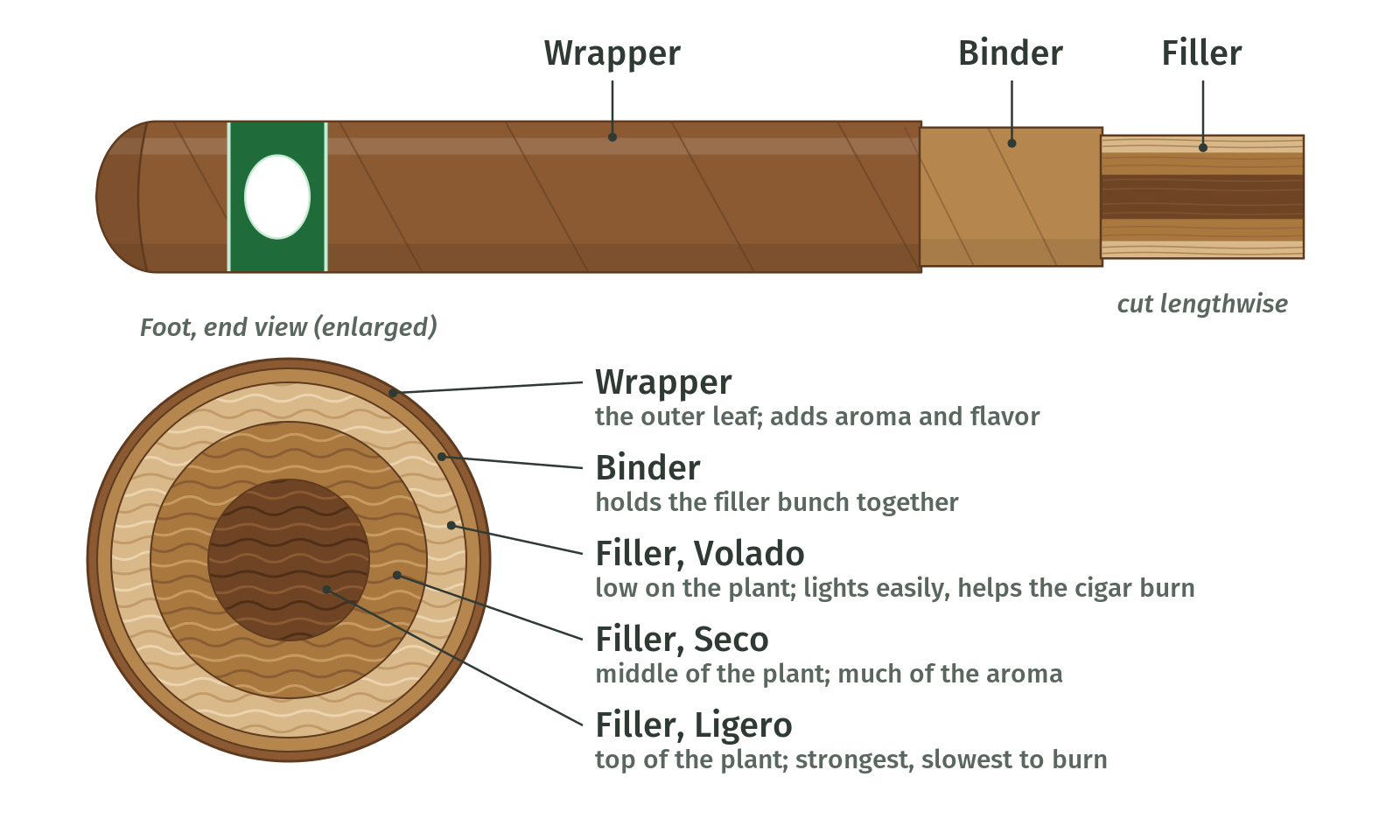
The wrapper (capa in Spanish) is the last leaf the roller applies. It has to stretch without tearing, lie smooth from foot to head, and look like one smooth leaf wrapper when the seam is done. Factories pay more for wrapper than for almost any other leaf in the cigar, because defects show and because that leaf contributes smoke to each and every puff.
A wrapper contributes aroma and flavor — often the first note on a cold draw and a large share of what you smell as the cigar burns — but the wrapper does not make the whole smoke. The same cover leaf over two different filler recipes will not taste the same. Shade-grown wrappers (the classic example is Connecticut shade, grown under cloth) tend to be thinner and more elastic. Sun-grown leaves such as many habano wrappers are thicker and oilier. The color terms — claro, colorado, natural, maduro, oscuro — describe the finished look and, in the case of maduro, often a longer fermentation path. They are not separate plant species.
A dry wrapper cracks in a badly maintained humidor. Storage and cutting technique matter because the wrapper leaf is a key element of the cigar structure. The glossary entries for each wrapper color give more detail.
The Binder: The leaf that holds the filler together
The binder (capote) wraps the filler bunch so it stays together on the table, in the wooden cigar mold, and under the wrapper. You rarely see it on a finished cigar. That is the point. It is a structural element, not a visual aesthetic one.
A good binder needs to burn. A leaf that will not burn well leads to burn inconsistencies such as a “canoe” burn, where one side of the cigar burns faster than the other; a “run,” where the burn races up a narrow channel along the wrapper; a “tunnel” burn; or the cigar may simply go out. The binder also has to be strong enough to hold a bunch without adding a lot of flavor of its own — though some binders are chosen because they do add flavor notes. Small blemishes that would disqualify a wrapper are acceptable on binder leaf; tensile strength and burn matter more for a binder leaf than does appearance.
A double binder is two binder leaves instead of one. Rollers use it when a single sheet will not hold the bunch, when the blender wants a particular burn, or when a second leaf is part of the recipe, rather than a repair. It is a construction choice, not a marketing novelty.
The Filler: Where the blend lives
Filler (tripa) is the interior core tobacco of the cigar. In the premium handmade cigars this encyclopedia covers, that means long filler: whole leaves, or large pieces of them, running the length of the cigar. Short filler (chopped leaf and trimmings) is a different product; mixed filler puts short leaf inside a long-filler bunch. Those distinctions are laid out in the section “What is a premium cigar?” and also in the Handmade-versus-machine-made chapter.
How filler leaves are arranged matters as much as which leaves they are. A plugged bunch draws like a straw with a knot in it. A loose bunch burns hot and uneven. The blender’s recipe and the roller’s skill are both showcased in the draw and the burn of a great cigar.
Filler primings: volado, seco, ligero
Tobacco plants are harvested by priming: leaves come off from the bottom of the stalk upward as they ripen.
- Volado sits nearest the ground. It sees less sun, stays thinner, and lights more easily than the primings above it. In the bunch it helps keep the cigar lit, because the heavier leaves burn slowly and tend to go out. A cigar of nothing but volado would burn and not say much. A cigar with no volado can be a chore to keep going, especially in a large ring gauge.
- Seco sits in the middle. Many blenders count on it for aroma and for a middle register that is neither combustion-only nor all strength. Compared with volado it has more flavor; compared with ligero it burns more willingly. If a blend feels hollow — smoke without a center — seco is one of the first places a blender looks.
- Viso sits between seco and the true top leaf: more body than seco, more burn than the heaviest crown leaf. Some houses skip the name and sort only three filler grades. Others keep viso as its own separate grade.
- Ligero is an upper-stalk leaf: denser, oilier, stronger, and slower to burn. It needs more fermentation and more aging than seco or volado. Rush it and the cigar tastes green and sharp. Leave it out entirely and many full-bodied blends go hollow. Too much ligero in a thin vitola such as a lancero can make a stubborn burn; a robusto or a thicker vitola has more room to bury a strip of it inside seco and volado.
Those four words are the ladder, not a tasting wheel. Two ligero leaves from different farms will not smoke the same. The priming tells you where the leaf grew on the plant.
How the three leaf layers work together
A Master Blender is balancing combustion, body, and the wrapper leaf’s contribution against a chosen vitola. Change the size and the same recipe will not burn the same way — that’s why a cigar line comes in several formats that are by no means clones. The wrapper frames the smoke; the binder holds and helps the burn; the filler carries most of the strength and the middle of the flavor.
Blends and puros
When filler, binder, and wrapper all come from one country, the cigar is a puro. When origins are mixed, it is a blend. Neither is necessarily better. A Nicaraguan puro such as many Padrón cigars is one recipe philosophy; a Dominican house that pairs local filler with an Ecuadorian or Connecticut wrapper is another.
Where to go next
- Anatomy refresher: what is a premium cigar.
- Seed to box: how cigars are made.
- Size and session length: ring gauge and length, then robusto.
- Choosing a first stick: choosing a first premium cigar.
- Cutting and lighting without wrecking the wrapper: how to cut and light a cigar.
- Words: glossary entries for wrapper, binder, filler, and the primings above.
- The full course: Cigars 101.
Smoke Rings sells the tools and not the tobacco: cutters, lighters, and humidors from eBay listings (seller us-grai), plus empty cigar boxes for collectors. For the cigars themselves, our sponsor AbsoluteCigars.com is your best source!
Sources: Established trade descriptions of wrapper (capa), binder (capote), filler (tripa), filler primings (volado, seco, viso, ligero), double binders, and puro vs multi-origin blends. No statistics, scores, or tasting notes.