Every other chapter of Cigars 101 assumes you know what you are holding. But here, defining the product quickly, seems a good place to kick-off this publication. We’ll cover what the cigar trade means by “premium cigar”, what each part of the cigar is called, which leaves make up a cigar, and how a handmade cigar differs from the machine-made cigars you may find sold at the gas/petrol station counter. Sizes and humidors are covered later in this book. The vocabulary starts here.
What “premium” means
“Premium” is a trade word, not a grade stamped by one authority. Regulators and tax offices in some countries have written their own definitions for their own purposes. This chapter uses the everyday meaning a tobacconist would recognize. In that sense a premium cigar is:
- Tobacco leaf all the way through — filler, binder, and wrapper — with no paper and no reconstituted tobacco or non-tobacco fillers.
- Made by hand, or at least bunched and wrapped by people at a rolling table rather than by a continuous automated machine.
- Rolled with long filler: whole leaves, or large pieces of them, running the length of the cigar.
- Finished with a whole natural wrapper leaf and a cap applied by hand.
- Meant to be smoked slowly, with the smoke held in the mouth rather than inhaled.
Some cigar makers create hand-rolled cigars with chopped filler and sell them as value lines. Some machine-bunched cigars get a hand-applied wrapper. The core idea is whole leaf, handwork, and time: the tobacco is grown, cured, fermented, and aged before it reaches a roller, and the finished cigars usually rest again before they ship. That long road is covered in our chapter How cigars are made.
Anatomy: from cap to foot
Pick up a cigar and study it from the end that goes in your mouth to the end you light.
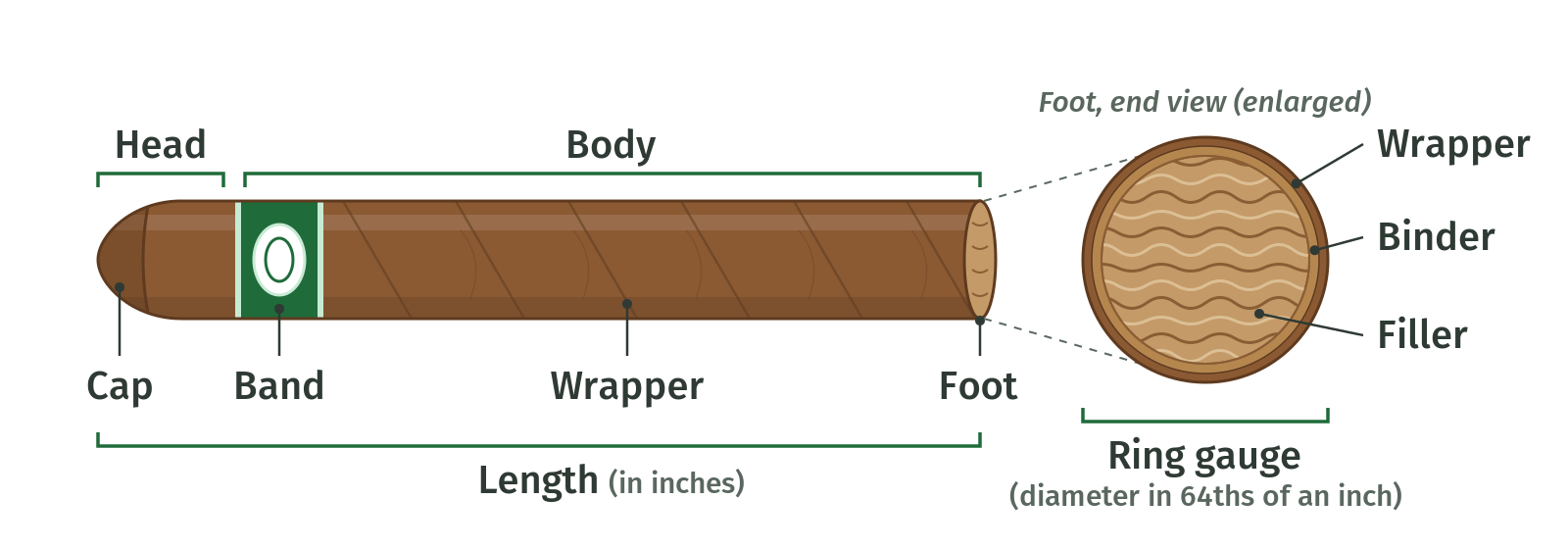
Head and cap
The head is the closed end. On most cigars it is rounded; on a torpedo or belicoso it comes to a point (see torpedo and belicoso). The head is sealed by the cap, a small piece of wrapper leaf cut to shape and stuck down with a tasteless vegetable gum. Some rollers apply the cap in layers; the triple cap is closely associated with Cuban rolling tradition. Others finish the head with a twisted pigtail, a common touch on lanceros.
The cap is what you open before smoking. You cut into the cap, not through it and down into the body, or the wrapper can start to unwind. The technique is in how to cut and light a cigar; the tools are reviewed and compared in cutter types.
Shoulder
The shoulder is where the rounded head meets the straight body. It is the practical limit for a cut. Don't cut below that line which could risk causing the wrapper to unravel.
Body
The body, sometimes called the barrel, is the bulk of the cigar. Look closely and you’ll see the wrapper’s seam running in a spiral from foot toward head. A cigar with straight, parallel sides is a parejo. A cigar with a tapered head, a tapered foot, or a bulge in the middle is a figurado. A box-pressed cigar has been squared off in cross-section but is still a parejo in shape. Length and diameter together make the size, or vitola; the numbers are explained in our ring gauge and length cheat-sheet.
Foot
The foot is the end you light. On most premium cigars it is cut flat and open, so you can see the ends of the filler leaves folded inside. Some shapes close or taper the foot, as on many perfectos. Some makers leave a little uncut filler sticking out past the wrapper (often called a shaggy foot), or fold wrapper leaf over the end (a covered foot). Those are style choices; they change the first few puffs, not the definition of a cigar.
Band
The band is the printed paper ring near the head. Its practical job is identification and brand recognition. Bands are also a collecting field of their own — the Smoke Rings band museum shows hundreds of them. Whether you take the band off before smoking is a matter of taste. If you do, wait until the cigar has warmed for a while so the glue lets go without tearing the wrapper.
Many cigar fans have substantial cigar band collections. It is a fun side-hobby for those inclined, and cigar bands or small collections are commonly available for sale for those looking to boost their collection easily.
Most non-Cuban cigars now come protected in cellophane sleeves. Other protective packaging includes cedar sleeves, and aluminum or glass tubes (“tubos”). They protect a cigar in transit and on a shop shelf.
The Three Leaves
Cut a premium cigar in half lengthwise and you’ll find three layers, each serving a different purpose.
- Filler (tripa) is the core: several leaves, often from different parts of the plant, different farms, and sometimes even different countries. Leaf from low on the plant (volado) helps the cigar burn; middle leaf (seco) carries much of the aroma; top leaf (ligero) is thicker and stronger and burns slowly. The cigar blender balances them so the cigar stays lit and holds together, building flavor.
- Binder (capote) is the leaf wrapped around the filler bunch to hold it together. It needs strength and elasticity more than good looks. Some cigars use two binder leaves, a double binder.
- Wrapper (capa) is the outer leaf. It has to be thin, elastic, evenly colored, and free of tears, which makes it the hardest leaf to grow and usually the most expensive in the cigar. This is what you see and touch first, and it contributes its own aroma and flavor. Wrappers range from pale claro through colorado to dark maduro and oscuro, and they may be grown under shade cloth or in full sun.
When all three layers come from one country the cigar is called a puro; otherwise it is a blend. Neither is automatically better. For how a filler bunch is actually formed, see entubado and accordion bunching.
Long filler, short filler, and machine-made
The filler is commonly where premium and everyday cigars part ways.
- Long filler uses whole leaves laid or folded along the cigar’s length. Well bunched, it burns evenly, holds a firm ash, and lets the blender control how the leaves combine. This is the norm for premium cigars.
- Short filler uses chopped leaf and trimmings, including offcuts from long-filler production. It is cheaper, tends to burn faster and hotter, and sheds loose bits of tobacco. It appears in machine-made cigars and in some hand-rolled so-called “value” lines. A mixed-filler cigar puts short filler inside a long-filler bunch.
- Machine-made cigars are formed by machines at high volume. Many use a sheet of homogenized, or reconstituted, tobacco as the binder and sometimes the wrapper. Flavored and tipped cigars, cigarillos, and filtered little cigars mostly belong here. They are built for consistency and price, not for slow aging of whole leaf.
Smoke Rings focuses on handmade premium cigars. Nothing here is a judgment of anyone’s preferences; this information is simply for you to know what the label on the box is describing. For a fuller comparison of machine-made cigars, homogenized tobacco leaf (HTL), hand-finished cigars, and how to check the foot of a cigar, see handmade vs machine-made.
How to recognize a handmade cigar
No single sign proves how a cigar was made, and counterfeiters copy the outside carefully. Together, these clues are a reasonable first read:
- The head shows a separately applied cap, with a faint line where it meets the body, rather than a pressed or crimped machine finish.
- The foot shows whole leaves folded in cross-section rather than a uniform mass of shreds.
- The wrapper looks like leaf: fine veins, natural variation in color, some oil, one neat spiral seam.
- The feel is evenly firm from foot to head, with a little give. Hard knots or hollow soft spots suggest a bunching problem.
- The shop keeps its stock in a humidified room or cabinet, because whole-leaf cigars dry out and crack without it.
Construction quality is easier to spot once the cigar is lit: an easy draw, an even burn, and a firm ash. A white bloom on a wrapper may be harmless plume (crystalized tobacco oils) or it may be mold — see the glossary entry Plume vs mold, where we explain the difference in detail.
Where to go next
- Size: ring gauge and length, then the robusto guide for the most common modern size.
- Choosing: choosing a first premium cigar.
- Smoking: how to cut and light a cigar.
- Storage: first humidor setup and humidor (storage).
- Words: the glossary.
- The full course: Cigars 101.
Smoke Rings sells the tools and not the tobacco: cutters, lighters, and humidors from eBay listings, plus empty cigar boxes for collectors. For the cigars themselves, Absolute Cigars (absolutecigars.com) is next door.
Sources: Established trade descriptions of cigar construction (cap, head, foot, filler primings, binder, wrapper; long vs short filler; machine-made cigars and homogenized tobacco). No statistics, scores, or tasting notes.