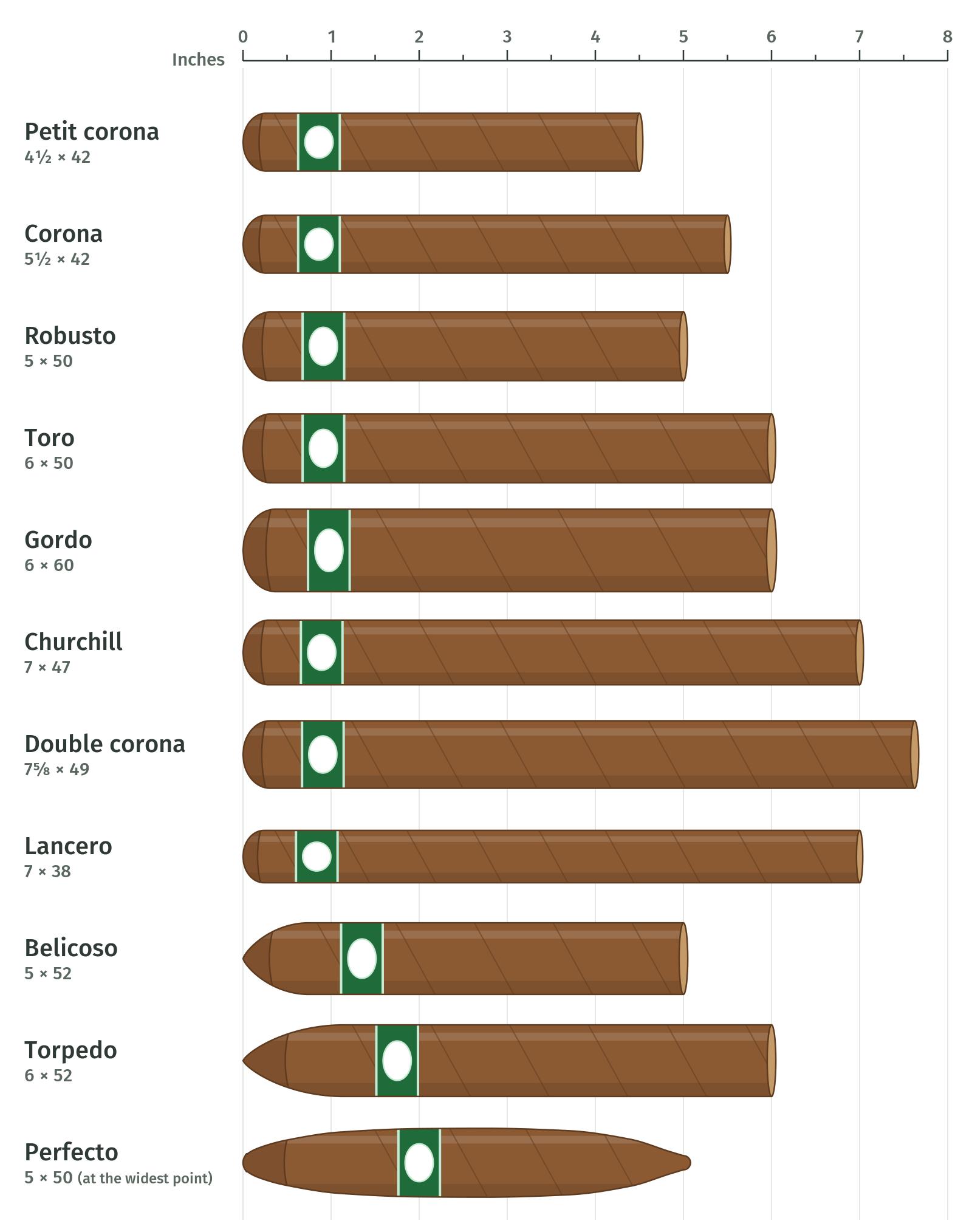
Ring gauge refers to the cigar’s thickness, and length is, of course, how long it is. A vitola is the combination of the two, and it often has a distinct traditional size name, for example “churchill” or “corona”. A ring gauge of 50 means the cigar is 50/64 of an inch across. The size name on a band is less exact than the measurements printed by the maker, so rely on the numbers.
This chapter gives an overview of cigar sizes. The guides linked below cover each size in more detail.
How to read a size
- Length — given in inches in American catalogs (5, 6, 7, and so on) and in millimeters outside the US and on many factory spec sheets.
- Ring gauge — measured in 64ths of an inch. A 42 is slender. A 50 is the most common modern thickness. A 60 is considered very thick.
- Name — robusto, corona, Churchill, toro, lancero, belicoso, perfecto. These names come from tradition rather than exact measurements, so one maker’s “toro” may be another maker’s “corona gorda.”
Cigars are either parejo (straight-sided) or figurado (shaped). A box-press gives a parejo square sides, but it does not change the cigar’s length and ring gauge.
Common ranges (traditional, not fixed rules)
- Robusto — usually about 4½–5½ inches long with a ring gauge of about 48–52; the most typical size is 5 × 50. Guide: robusto.
- Corona — classically about 5½ × 42; a petit corona is shorter and a corona gorda is thicker. Guide: corona and petit corona.
- Lonsdale — a slim, medium-long size, traditionally about 6–6½ × 42–44.
- Toro — a thicker modern size, commonly about 6 × 50–54.
- Churchill — classically about 7 × 47 (the Julieta No. 2); shorter and thicker versions also use the name. Guide: Churchill.
- Lancero — long and thin, often about 7 × 38. Guide: lancero.
- Torpedo / belicoso — a pointed head; a belicoso is usually shorter. Guide: torpedo and belicoso.
- Perfecto / figurados — both ends tapered with a bulge in the middle; part of the wider figurado family. Guide: perfecto and figurados.
For a one-line definition of each term, see the terms A–Z index.
What size changes (and what it does not)
Size affects how long the cigar lasts, how it draws, and how much wrapper there is compared with filler. A Nicaraguan robusto and a Nicaraguan Churchill can share the same blend and still burn differently because their shapes differ. For that reason, the very best cigar lines adjust the blend for different sizes instead of using one identical recipe for every size.
What size is best is a matter of personal choice.
Keep going on this site
Brand background: brands hub. Reviewed cigars: Reviews. Bands and boxes: museum. How a cigar is built: how cigars are made. Storage: humidors. Accessories: cutters, lighters, humidors, empty boxes. Smoke Rings does not sell tobacco. For the cigars themselves, our sponsor AbsoluteCigars.com is your best source.
Sources: Standard trade definitions of ring gauge (64ths of an inch); commonly cited traditional vitola ranges; Smoke Rings practice that factory names drift and printed dimensions govern.