Two different cigars are sold under the name Cohiba. One is the Cuban Cohiba, made in Havana and sold around the world by Habanos S.A. The other is the U.S.-market Cohiba, made mainly in the Dominican Republic and sold only in the United States by companies of Scandinavian Tobacco Group. The two companies have been in a legal dispute over the U.S. rights to the name since January 1997. In this chapter of Cigars 101 we look at how that happened, review the main court rulings in order, and outline where the case stands as of October 2026, with a clear outlook as to where this case is heading. We look at why the dispute matters less to smokers than it does to lawyers, and how to tell the two cigars apart. The brand profiles are Cohiba (Cuba) and Cohiba (Dominican).

This chapter describes court records and public reporting. It is not legal advice, and it does not take either company's side.
Why the name matters
The Cuban Cohiba was created in 1966. According to Habanos S.A., for many years it was made only as a gift for Cuban and foreign government figures and for Fidel Castro, and it has been made since then at the El Laguito factory in Havana. Habanos says the name comes from an old Taíno word for the rolled tobacco leaves that Columbus saw in Cuba in 1492, and that the leaf comes from the San Juan y Martínez and San Luis areas of the Vuelta Abajo in Pinar del Río.
The Cohiba was not only a gift cigar. A federal court in Virginia found in 2025 that Cubatabaco, the Cuban state tobacco company, began selling Cohibas in Cuba in 1970. It sold them in Havana's main hotels, in upscale restaurants, in two shops for foreigners and embassy staff, and to Cuba's Council of State, which gave them away as official gifts. Cohiba became known as "Castro's cigar." Cohiba went on sale outside Cuba in 1982. Cigar Aficionado reports that Spain was the first market. Today the Cuban Cohiba is sold in every major cigar market except the United States, where U.S. embargo rules make it illegal to import or sell Cuban cigars.
Cohiba is different from most parallel brands such as Montecristo, Partagás, and H. Upmann. Those brands existed before the 1959 revolution. Their Cuban owners lost their factories, left Cuba, and later sold or used the U.S. rights to the old names. Cohiba was created after the revolution by the Cuban state, so no family in exile had ever owned it. When General Cigar registered the name in the United States, it did not buy it from anyone. That is the main reason the Cohiba dispute is harder to settle than the others.
The Cuban trademark

Court records give the dates of Cuba's own registrations. In September 1969, Cubatabaco applied in Cuba to register a "mixed" mark: a drawing of a fan with the word "Cohiba" under it. Cuba registered it on May 31, 1972, for 15 years. In March 1972, Cubatabaco applied to register the word COHIBA alone. That registration was issued on July 1, 1980. By January 1978, Cubatabaco had applied to register COHIBA in seventeen countries, including most of Western Europe, but not in the United States.
The U.S. Cohiba
General Cigar was one of the largest U.S. makers of premium cigars. In 1976 it bought the U.S. rights to three pre-revolution Cuban brands from the Cifuentes family, and it then looked for other Cuban-sounding names to use. On November 15, 1977, Forbes magazine published an article about the U.S. cigar industry that called Cohiba "Fidel's favorite brand." In December 1977, a list of possible new trademark names reached General Cigar's trademark manager. Cohiba was first on the list. Notes on the list and in the file memo said "Castro's brand cigars," "sold in Cuba," and "brand in Cuba."
On March 13, 1978, General Cigar applied to register COHIBA with the U.S. Patent and Trademark Office (USPTO). No one opposed it, and the registration (No. 1,147,309) was issued on February 17, 1981. General Cigar sold Cohiba cigars in the United States from 1978 until late 1987. Then it stopped shipping them for about five years, during a weak period for premium cigars.
In 1992 the Cuban Cohiba became well known to American smokers. In February 1992, Wine Spectator described it as Cuba's "finest" cigar. In September 1992, the first issue of Cigar Aficionado gave the Cuban Cohiba Robusto its top rating. On November 20, 1992, General Cigar launched a new premium cigar under the Cohiba name. The district court later noted that General Cigar acknowledged the relaunch was at least partly a response to Cigar Aficionado's coverage of the Cuban Cohiba. On December 30, 1992, General Cigar applied to register a stylized form of COHIBA, and that registration (No. 1,898,273) was issued on June 6, 1995.
In the fall of 1997, General Cigar launched a new version of its Cohiba with much more advertising. This is the cigar known as the "Red Dot" Cohiba, for the red dot inside the "O" of the logo. The current Red Dot is made in the Dominican Republic with a Cameroon wrapper, an Indonesian (Jember) binder, and Dominican Piloto Cubano filler, according to the brand. General Cigar is owned by Scandinavian Tobacco Group (STG). On February 2, 2026, STG moved U.S. sales of Cohiba from General Cigar to Forged Cigar Company, its other U.S. sales division. General Cigar Co., Inc. is still the registered owner of both U.S. trademarks.
Timeline of the legal dispute
1997: two cases begin. On January 15, 1997, Cubatabaco applied to register COHIBA in the United States. A U.S. Treasury general license allows Cuban companies to register and renew trademarks at the USPTO even under the embargo. The USPTO refused the application because General Cigar's registrations were already on the register. In January 1997 Cubatabaco also asked the USPTO's Trademark Trial and Appeal Board (TTAB) to cancel General Cigar's two registrations (Cancellation No. 92025859). In October 1997, Cubatabaco obtained a specific license from the Treasury's Office of Foreign Assets Control (OFAC) to bring a lawsuit. On November 12, 1997, it sued General Cigar and its then parent, Culbro Corporation, in federal court in New York. At Cubatabaco's request, the TTAB suspended its case until the lawsuit ended.
2002: first ruling in New York. On June 26, 2002, Judge Robert W. Sweet of the U.S. District Court for the Southern District of New York ruled that General Cigar had abandoned its 1981 registration by not using the name from 1987 to 1992. He also dismissed Cubatabaco's claims under Articles 7 and 8 of the Inter-American Convention and under the Paris Convention's famous-marks article, holding that those claims could not be brought through the part of the federal trademark law Cubatabaco relied on.
2004: Cubatabaco wins at trial. After a trial without a jury, Judge Sweet ruled in March 2004 that by November 1992, when General Cigar restarted its Cohiba, the Cuban Cohiba was already well known to U.S. cigar smokers. Under the "famous marks" doctrine, he held that Cubatabaco owned the U.S. rights to the name even though it had never sold a cigar in the United States. He found a likelihood of confusion between the two cigars, cancelled General Cigar's registration, and ordered General Cigar to stop using the name. General Cigar appealed.
2005: General Cigar wins on appeal. On February 24, 2005, the U.S. Court of Appeals for the Second Circuit reversed. It held that the embargo regulations (the Cuban Assets Control Regulations) bar a Cuban company from acquiring property rights in a U.S. trademark through the famous-marks doctrine. It also held that cancelling General Cigar's registration and stopping its sales, as the trial court had ordered, would transfer property rights to a Cuban company in violation of the embargo. The court did not decide whether the famous-marks doctrine exists in U.S. law, and it did not decide whether General Cigar had abandoned its first registration. It agreed that the treaty claims had been properly dismissed. The court denied rehearing on June 1, 2005.
2006: the Supreme Court declines. Cubatabaco asked the U.S. Supreme Court to hear the case. The Court asked the Solicitor General for the U.S. government's views, and the government filed a brief in May 2006. On June 19, 2006, the Supreme Court denied the petition (No. 05-417).
2007 and 2008: the TTAB question. General Cigar asked the New York court to order the TTAB to dismiss Cubatabaco's cancellation case. The court declined on March 14, 2007, and said the TTAB should decide what effect the Second Circuit's ruling had on the TTAB case. The Second Circuit affirmed on September 4, 2008.
2008 to 2010: a second try in New York. In December 2007, New York's highest court decided a different case, ITC v. Punchgini, about foreign marks and New York unfair-competition law. Cubatabaco used that decision to ask Judge Sweet to reopen its New York unfair-competition claim, and on November 19, 2008, he agreed. On July 14, 2010, the Second Circuit reversed that ruling, holding that the New York decision had not changed the law in a way that justified reopening the case.
2011 to 2013: back at the TTAB. The TTAB case resumed in June 2011, and Cubatabaco filed an amended petition. On March 14, 2013, the TTAB dismissed it. The TTAB held that Cubatabaco lacked standing because of the Second Circuit's final judgment that the embargo barred it from acquiring any property interest in the COHIBA mark in the United States.
2014 and 2015: the Federal Circuit reverses the TTAB. On June 4, 2014, the U.S. Court of Appeals for the Federal Circuit, which hears appeals from the TTAB, vacated the TTAB's decision. It held that Cubatabaco had a legitimate interest in cancelling General Cigar's registrations because those registrations were blocking its own application. It held that the Second Circuit had decided only that a federal court could not order relief against General Cigar under the embargo rules. It had not decided whether Cubatabaco could seek cancellation at the USPTO, which the embargo's general license allows. The court also held that the earlier New York judgment did not bar Cubatabaco's TTAB claims. General Cigar asked the Supreme Court to review this decision, and the Court denied the petition on February 23, 2015 (No. 14-512).
2022: the TTAB cancels General Cigar's registrations. On December 20, 2022, the TTAB granted Cubatabaco's petition under Article 8 of the 1929 General Inter-American Convention for Trade Mark and Commercial Protection, a treaty that both the United States and Cuba have joined. Under Article 8, the owner of a mark protected in one member country can cancel a later registration of the same mark in another member country if it proves two things. First, its mark had legal protection in its home country before the other party applied. Second, the other party knew of the mark's use before it applied. The TTAB found that Cubatabaco proved both, and it ordered General Cigar's two registrations cancelled.
2023 to 2025: General Cigar sues in Virginia and loses. On February 20, 2023, General Cigar filed a civil action in the U.S. District Court for the Eastern District of Virginia. Federal trademark law lets a party that loses at the TTAB either appeal to the Federal Circuit or file a new case in district court, where the judge reviews the matter fresh and can take new evidence. General Cigar chose the district court. On May 7, 2025, Judge Leonie M. Brinkema ruled for Cubatabaco and dismissed General Cigar's case with prejudice. She found:
- Cubatabaco's 1972 Cuban registration of the fan-and-word mark protected the word "Cohiba" by itself under the Cuban law in force in 1978, and that registration had not lapsed.
- General Cigar knew in March 1978 that Cohiba was a cigar brand used in Cuba. She relied on the Forbes article and on the notes in General Cigar's own trademark file.
- The embargo regulations do not prevent the TTAB from cancelling the registrations, because cancellation at the USPTO falls under the embargo's general license for trademark registration matters. She treated the Federal Circuit's 2014 ruling as the law of the case.
In a footnote, Judge Brinkema said her ruling did not decide whether granting Cubatabaco's own U.S. application would violate the embargo regulations.
2025 to 2026: the Fourth Circuit appeal. General Cigar appealed to the U.S. Court of Appeals for the Fourth Circuit (No. 25-1645). Trade press reported that in its October 2025 brief, General Cigar did not challenge the judge's findings on Cuban trademark protection or on its knowledge in 1978. It argued instead that the embargo bars this cancellation, that the Second Circuit's 2005 judgment should have ended Cubatabaco's claims, and that Cubatabaco had pursued the same claims in several courts and agencies. The Fourth Circuit heard oral argument on September 16, 2026.
What each side argues
General Cigar's position. General Cigar says it was the first to use and register COHIBA in the United States, in 1978, and that it has built and sold the U.S. brand for decades. It argues that the embargo bars any ruling that takes trademark rights from a U.S. company to benefit a Cuban company, which is what the Second Circuit held in 2005. It argues that the 2005 judgment, which became final when the Supreme Court denied review in 2006, should have prevented Cubatabaco from bringing the same dispute back to the TTAB. In the Virginia case it also argued that Cuba's 1972 registration protected only the fan design with the word, not the word alone, that the Cuban mark had lapsed, and that giving cigars away as gifts was not trademark use. The district court rejected those three arguments.
Cubatabaco's position. Cubatabaco says Cohiba was a Cuban brand, protected under Cuban law, before General Cigar applied in the United States, and that General Cigar chose the name knowing it was Castro's cigar. It argues that the Inter-American Convention gives it the right to cancel a registration filed with that knowledge. It argues that the embargo's general license allows Cuban companies to register trademarks and to bring cancellation proceedings at the USPTO, which the Federal Circuit accepted in 2014. In the earlier New York case it also argued that the Cuban Cohiba was famous in the United States by 1992 and that General Cigar's 1992 and 1997 launches were meant to trade on that fame.
Where it stands as of October 2026
As of October 20, 2026:
- The TTAB has ordered General Cigar's two U.S. COHIBA registrations cancelled, and a federal district court upheld that order in May 2025.
- General Cigar's appeal to the Fourth Circuit was argued on September 16, 2026. We found no decision as of October 20, 2026.
- The cancellation has not been carried out. The USPTO's records still list both registrations (No. 1,147,309 and No. 1,898,273) as live, owned by General Cigar Co., Inc., with a cancellation proceeding pending.
- The U.S. Cohiba is still sold in U.S. shops. Since February 2, 2026, it has been sold by Forged Cigar Company.
- The Cuban Cohiba still cannot legally be imported or sold in the United States.
- No court has decided whether Cubatabaco can register COHIBA in its own name in the United States.
Smoke Rings will update this section when the Fourth Circuit rules.
Outlook: how it may play out
This section is our outlook, not established fact. It is based on the rulings above and on public reporting, and any of it may turn out wrong.
If the Fourth Circuit upholds the cancellation. General Cigar could ask the full Fourth Circuit to rehear the case or ask the Supreme Court to review it. If those steps fail, the USPTO would remove the two registrations. That would not, by itself, put Cuban Cohibas in U.S. shops, because the embargo would still apply. It also would not, by itself, be a court order to stop selling the U.S. Cohiba. A registration and the right to use a name are related but not the same thing, and the Second Circuit's 2005 ruling against an order stopping General Cigar's sales has not been overturned. Cubatabaco would then have to press its own application, which raises the embargo question Judge Brinkema left open. More rounds of litigation seem likely in that case.
If the Fourth Circuit reverses. General Cigar's registrations would stay in force. Cubatabaco could ask the Supreme Court to review the case. It might argue that the Second, Federal, and Fourth Circuits have treated the embargo question differently, which is the kind of conflict the Supreme Court sometimes takes cases to resolve. The Court declined the Cohiba case twice, in 2006 and 2015, so further review is not certain.
If the embargo is lifted. The trade embargo was written into federal law by the LIBERTAD Act in 1996, so ending it would most likely require an act of Congress. If Cuban cigars could be sold in the United States, two different cigars named Cohiba could be on the same U.S. shelves for the first time. Trademark law is meant to prevent two sellers from using the same name for the same product, so that situation would probably lead to new lawsuits, a negotiated settlement, a license, or one cigar being renamed. The same question would arise for Montecristo, Partagás, Romeo y Julieta, and the other parallel brands. Cigar Aficionado wrote in 2018 that legal battles and long negotiations are likely if that happens, and that no one can do more than speculate about the result.
A settlement. The two companies could settle at any time. Under the current embargo rules, though, many business dealings with a Cuban state company need a U.S. government license, which makes a private settlement harder than in an ordinary trademark case.
For the smoker, a quirk of the cigar industry
For people who buy and smoke cigars, the Cohiba dispute is mostly a quirk of the cigar industry. It generally does not cause confusion, at least not for people with a good amount of knowledge and experience of cigars and the cigar industry.
The reason is simple. Experienced smokers know that Cuban cigars cannot legally be sold in the United States. A Cohiba sold in a U.S. cigar shop or by a U.S. online retailer is the U.S. Cohiba. A Cohiba sold in a shop in London, Madrid, or Toronto is the Cuban one. The two cigars also look different and are made from different tobacco. U.S. shops already sell many other parallel brands that share a name with a Cuban brand, such as Montecristo, Romeo y Julieta, and Partagas, and experienced smokers deal with those every day.
The New York court found a likelihood of confusion between the two marks in 2004, as part of a judgment that the Second Circuit later reversed on other grounds. That was a legal finding about the marks. In our experience, the confusion that does happen involves new smokers, people buying a cigar as a gift, travelers bringing cigars home, and counterfeit "Cuban" Cohibas sold to people who do not know the difference.
How to tell the two apart
- Where it was sold. In the United States, a legal shop sells only the U.S. Cohiba. Outside the United States, authorized shops sell the Cuban one.
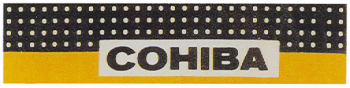
- The band. Cigar Aficionado describes the Cuban band as yellow and black, with a grid of white dots, bold lettering, and a Taíno head, and notes that newer bands add gold embossing and holographic features against counterfeits. The U.S. Red Dot logo has a red dot inside the "O" of COHIBA.
- The box. According to Habanos S.A., the bottom of every Cuban box is hot-stamped "Hecho en Cuba" and "Habanos s.a.", and boxes of long-filler cigars are also stamped "Totalmente a Mano." Cuban boxes carry the Cuban government warranty seal. Since 2009 that seal has a hologram and an individual bar code that you can check with the Authenticity Check on the Habanos website. The U.S. Cohibas are marked with their country of manufacture: the Dominican Republic for the Red Dot line, and other countries for some other U.S. Cohiba lines.
- The tobacco. The Cuban Cohiba uses Cuban leaf from the Vuelta Abajo. The U.S. Red Dot uses a Cameroon wrapper, an Indonesian binder, and Dominican filler grown from cuban seed. Cuban seed does not make a cigar Cuban; see Cuban vs New World.
Counterfeit Cuban Cohibas are common. A box of "Cuban" Cohibas offered in the United States, or at a low price anywhere, should be treated with suspicion.
Key terms
- Trademark: a name or symbol that identifies who makes or sells a product.
- Registration: a record of a trademark at a government office, such as the USPTO. A registration can be cancelled.
- Cubatabaco (Empresa Cubana del Tabaco): the Cuban state tobacco company that owns the Cuban Cohiba trademark and brought the U.S. cases.
- Habanos S.A.: the company that markets and distributes Cuban cigars, including Cohiba, around the world.
- General Cigar Co.: the U.S. company that registered COHIBA in the United States in 1978–1981 and still owns the U.S. registrations. Part of Scandinavian Tobacco Group.
- TTAB: the Trademark Trial and Appeal Board, the part of the USPTO that decides cancellation cases.
- Embargo: the U.S. ban on trade with Cuba. See embargo.
- Cuban Assets Control Regulations: the U.S. Treasury rules that carry out the embargo.
- Inter-American Convention (1929): a trademark treaty among countries of the Americas, including the United States and Cuba. Its Article 8 is the basis of the 2022 cancellation.
- Famous-marks doctrine: the idea that a foreign mark that is well known in a country can be protected there even if it has never been used there. The Second Circuit did not decide whether U.S. law recognizes it.
Where to go next
- The two brand profiles: Cohiba (Cuba) and Cohiba (Dominican).
- Why two cigar industries exist: Cuban vs New World and the cigar.
- Terms: embargo, cuban cigar, cuban seed, band, and the rest of the glossary.
- Spotting counterfeits: How to Spot Fake Cuban Cigars (planned chapter).
- The full course: Cigars 101.
Smoke Rings sells the tools and not the tobacco: cutters, lighters, and humidors. For the cigars themselves, our sponsor AbsoluteCigars.com is your best source.
Sources: Court records: Empresa Cubana del Tabaco v. Culbro Corp., 213 F. Supp. 2d 247 (S.D.N.Y. 2002); 399 F.3d 462 (2d Cir. 2005); 478 F. Supp. 2d 513 (S.D.N.Y. 2007); 541 F.3d 476 (2d Cir. 2008); 587 F. Supp. 2d 622 (S.D.N.Y. 2008); 385 F. App'x 29 (2d Cir. 2010); Empresa Cubana del Tabaco v. General Cigar Co., 753 F.3d 1270 (Fed. Cir. 2014); TTAB Cancellation No. 92025859 (decisions of Mar. 14, 2013 and Dec. 20, 2022); General Cigar Co. v. Empresa Cubana del Tabaco, No. 1:23-cv-227 (E.D. Va. May 7, 2025); Fourth Circuit No. 25-1645 (argued Sept. 16, 2026). U.S. Supreme Court dockets 05-417 and 14-512. USPTO TSDR records for Reg. Nos. 1,147,309 and 1,898,273 (checked Oct. 12, 2026). Habanos S.A. (Cohiba brand page; Marks of distinction). Cigar Aficionado ('Cohiba: A Legal Timeline', updated May 2025; 'What's In A Brand Name?', 2018). halfwheel (Oct. 2025 appeal brief; Jan. 2026 STG portfolio change). Tobacco Asia. Cohiba.com (Red Dot). Not legal advice.